
Get In Touch
Pudgy Squirrel Marketing
Google Business Profile vs. Google Ads: Which One Should a Contractor Invest in First?
By Tony
June 19, 2026
13 mins
Share:
Key Takeaways
- Google Business Profile (GBP) is free and should be fully optimized before a single dollar is spent on Google Ads because GBP directly affects how your paid ads perform and how much they cost.
- A fully optimized GBP generates consistent, free leads from the Google Local Pack the three-business map block that appears above organic results for local searches and competes directly with paid ads for visibility.
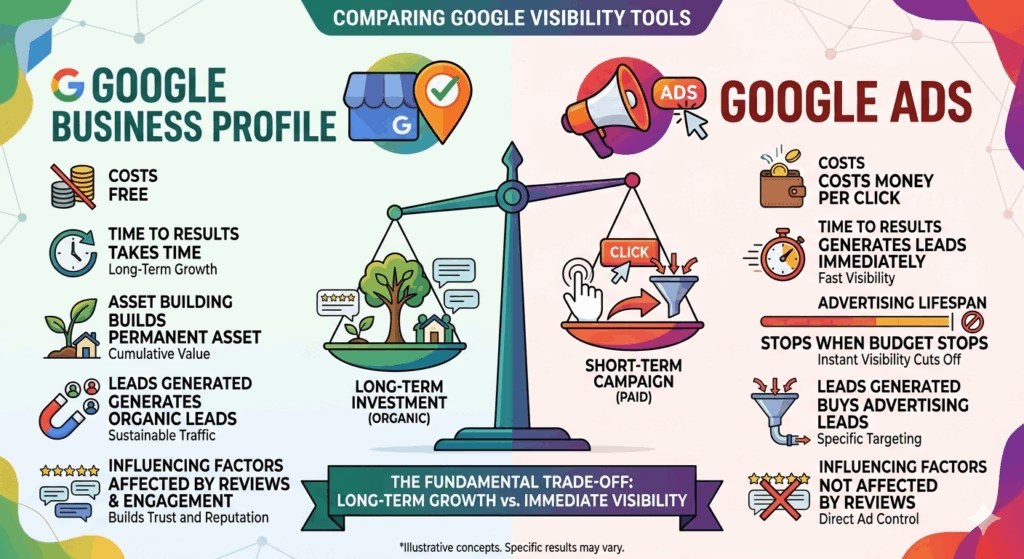
- Google Ads generates leads immediately, but stops the moment your budget runs out. GBP builds a compounding asset that continues producing results over time with minimal ongoing spend.
- For most contractors starting from scratch, the correct sequence is: optimize GBP first, then layer in Google Ads once the organic foundation is solid.
- There are specific situations new businesses, urgent revenue needs, highly competitive markets where running Google Ads before GBP is fully matured makes tactical sense.
- The strongest contractor marketing position combines both: a fully optimized GBP that generates free organic leads and a well-managed Google Ads campaign that captures the high-intent traffic that organic doesn’t reach yet.
The Question Behind the Question
When a contractor asks “Should I invest in Google Business Profile or Google Ads first?” they’re almost always really asking something more specific:
I have limited time and a limited budget. I need leads. What’s going to make the biggest difference, the fastest, without wasting money I don’t have to waste?
That’s a fair question and it deserves a direct answer based on how these two tools actually work, not a “well, it depends” non-answer that leaves you exactly where you started.
Here’s the short version: For most contractors, Google Business Profile comes first. It costs nothing, it affects your entire Google presence including your paid ads, and a fully optimized profile regularly generates leads that compete head-to-head with businesses spending thousands per month on advertising.
But “most contractors” isn’t “all contractors” and there are real situations where the calculus shifts. This post walks through both tools in depth, gives you the comparison framework, and ends with a clear decision guide based on where your business actually is right now.
Understanding the Two Tools: What They Actually Do
Before comparing them, it’s worth being precise about what each tool is and isn’t because contractors often have a fuzzy picture of one or both.
What Is a Google Business Profile?
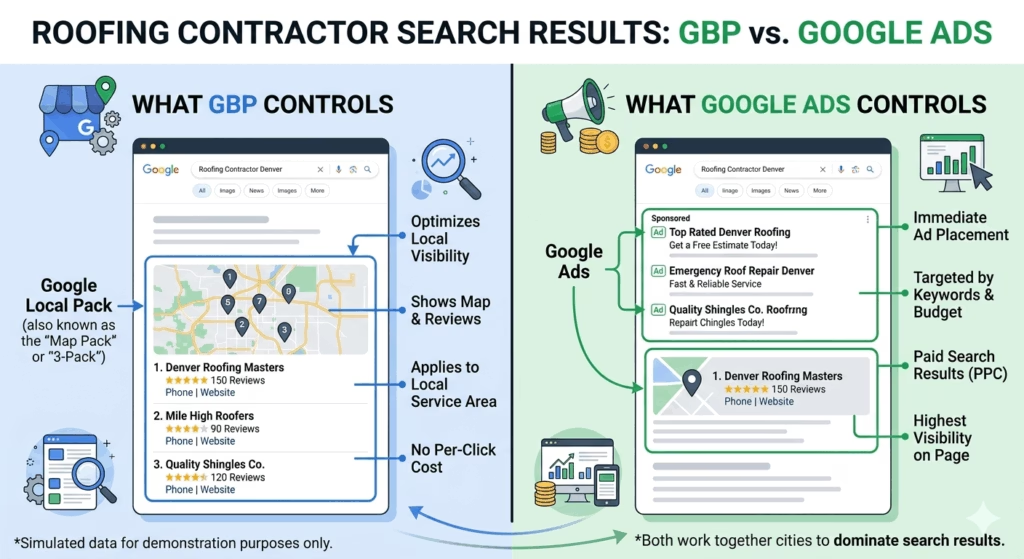
Google Business Profile (formerly Google My Business) is your free business listing on Google. When someone searches for a contractor in your area, it’s the information that appears in:
- The Google Local Pack — the map with three business listings that appears near the top of local search results
- Google Maps — when buyers search directly in the Maps app
- The Knowledge Panel — the business information box that appears on the right side of search results when someone searches your business name directly
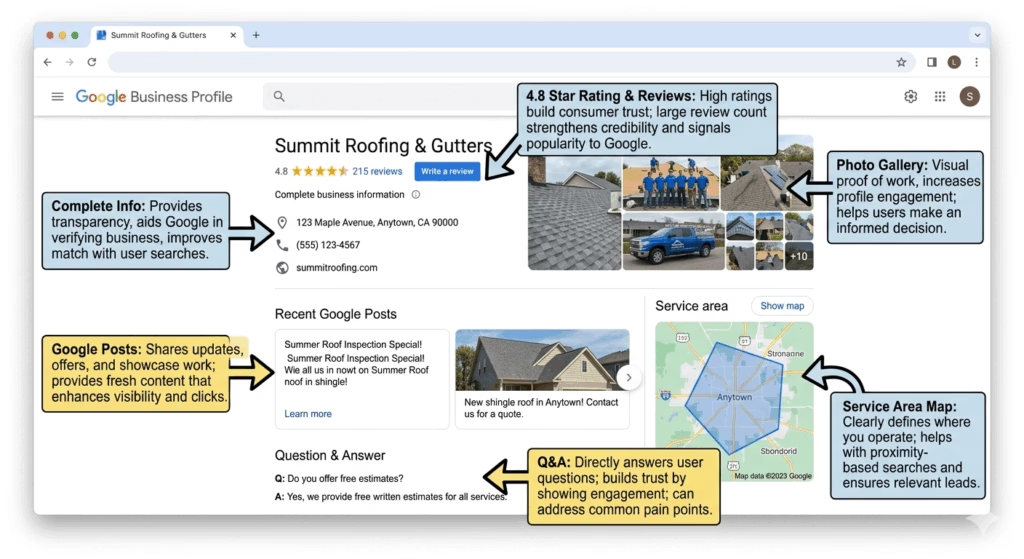
Your GBP displays your business name, address, phone number, hours, service area, photos, Google reviews, and posts. It links directly to your website and includes a “Call” or “Get Directions” button that makes it frictionless for mobile users to contact you instantly.
Critically: GBP is free. You don’t pay Google to appear in the Local Pack. You earn that visibility through profile completeness, review volume and quality, local relevance signals, and engagement metrics (clicks, calls, direction requests).
The trade-off is time. A GBP takes consistent attention over weeks and months to rank competitively in your market — it’s not instant.
What Are Google Ads?
Google Ads (specifically, Search Ads) are paid text advertisements that appear at the top of Google Search results above the Local Pack and above all organic results.
When a homeowner types “roof replacement near me” into Google, the first two to four results they see are typically paid ads. Your business can appear there by bidding on relevant keywords and paying each time someone clicks your ad.
The primary advantage of Google Ads is immediacy. Set up a campaign today and your business can appear in front of purchase-ready buyers tonight. No waiting for reviews to accumulate, no months of profile optimization just immediate visibility to people actively searching for what you do.
The trade-off: the moment you stop paying, the visibility disappears. Google Ads is a faucet, not an asset. And the faucet is only open as long as the budget is running.
Why Google Business Profile Almost Always Comes First
Reason 1: It’s Free — and Free Beats Paid When Execution Is Equal
The Local Pack appears above the fold on most desktop searches and dominates mobile search results. Studies consistently show that Local Pack listings receive a significant share of clicks on local search queries often more than the paid ads sitting above them.
For a contractor in a mid-size market, a fully optimized GBP can generate 15–40+ inbound calls and website visits per month at zero ad spend. That’s a cost-per-lead of essentially nothing, from leads that are actively searching for your service in your area.
No paid advertising channel including well-managed Google Ads can match a zero cost-per-lead at sustained volume. The businesses in the Local Pack aren’t there because they’re paying more. They’re there because they’ve invested the time to build a profile that Google trusts and that customers engage with.
Reason 2: Your GBP Directly Affects Your Google Ads Performance
This is the relationship most contractors don’t know about and it’s arguably the strongest argument for optimizing GBP before running ads.
Google Ads assigns every advertiser a Quality Score (1–10) based on several factors, including the relevance and trust signals associated with your business. A fully built-out GBP with consistent business information, strong review volume, and high engagement contributes to the local trust signals that affect how your ads perform.
More directly: Google Ads campaigns can be linked directly to your GBP through Location Extensions and Call Extensions, which display your address, phone number, and review rating directly in your ad. An ad with 4.8 stars and 85 reviews displayed beneath it gets dramatically more clicks than an identical ad with no review information.
If your GBP is thin, incomplete, or has few reviews, your ads both cost more and convert at a lower rate than they would with a strong profile behind them.
Bottom line: Optimizing your GBP makes your Google Ads more effective. Starting ads before the GBP is solid means you’re paying more per click for fewer conversions than you’d get if you’d done things in the right order.
Reason 3: GBP Builds a Permanent Asset; Ads Build Nothing
Every five-star review your GBP earns is permanent social proof that future customers will see for years. Every photo you upload compounds your visual credibility over time. Every Google Post you publish signals to Google that your business is active and engaged.
These are owned assets. Google cannot take them away when your budget runs out. They don’t disappear overnight. They build slowly and compound over time into a competitive moat that becomes harder and harder for new competitors to overcome.
Google Ads, by contrast, build nothing. The traffic you paid for last month is gone. The visibility you purchased last week disappeared the moment the campaign paused. Every dollar spent on ads is consumed, not invested.
For a contractor thinking about their business over a three-to-five year horizon, this distinction is enormous. The company that invests consistently in GBP optimization over two years will be generating leads at near-zero cost while competitors are still paying $30–$80 per click.
Reason 4: GBP Reviews Are Your Most Powerful Sales Tool
A Google Business Profile with 100+ reviews at 4.7 stars is not just an SEO asset it’s the first thing most potential customers see, and it’s doing active sales work every time someone finds your listing.
Reviews answer the questions buyers have before they’re willing to pick up the phone: Is this company reliable? Do they show up on time? Is the quality of work actually good? Will they leave my property a mess?
No ad copy, no website headline, no social media post answers these questions as powerfully as a stack of authentic, specific, recent reviews from real homeowners in the buyer’s own community.
Building that review volume takes time and a systematic approach but it starts with having a GBP that exists, is optimized, and has a review generation process attached to it. All of that needs to be in place before Google Ads become your primary focus.
When Google Ads Should Come First (Or Run Simultaneously)
The case for GBP first is strong but it’s not universal. Here are the specific situations where Google Ads should be a priority from the beginning.
Situation 1: You’re a New Business With No Reviews or Ranking History
A brand-new contractor cannot earn a Local Pack position in a competitive market in the first 90 days. GBP ranking is partly based on review volume, review recency, and profile engagement history none of which a new business has.
If you need revenue now to keep the business running while the GBP builds, Google Ads is the appropriate bridge. Run targeted ads in a tight geographic radius with a carefully chosen keyword list while simultaneously optimizing your GBP and building your first reviews. As the GBP matures, you can reduce ad spend gradually.
Situation 2: You’re in a Highly Competitive Market
In dense urban or suburban markets major metros where five roofing companies are advertising heavily and the Local Pack is dominated by established businesses with 200+ reviews building GBP visibility alone will take longer and produce less traffic than in lower-competition markets.
Here, Google Ads are often necessary to compete for immediate visibility while the longer-term organic strategy builds. The ads put your business in front of buyers who would otherwise scroll past your profile on page two. Over 12–18 months, as your GBP gains ground, you can adjust the balance.
Situation 3: You Have Capacity to Fill Fast
If you’re a contractor coming out of a slow season, dealing with unexpected crew downtime, or looking to fill a specific short-term revenue gap, Google Ads generates leads faster than any other channel. The immediacy is the point.
In these situations, running a focused Google Ads campaign for 30–60 days is a legitimate tactical decision as long as the GBP is at least minimally set up and the website can convert the traffic you’re about to send to it.
Situation 4: You’re Launching a New Service in an Existing Market
Your roofing business has been operating for five years. You decide to add commercial flat roofing to your service lineup. Your existing GBP has great reviews and strong local ranking but none of it is relevant to the commercial flat roofing market you’re entering.
Google Ads can bridge the gap while your reputation and SEO in the new service category builds. Run ads specifically for the new service, generate your first commercial jobs, collect reviews, and add that body of work to your profile and website. The ads accelerate what would otherwise be a slow organic start in a new category.
The Head-to-Head Comparison: How They Stack Up on the Metrics That Matter
| Factor | Google Business Profile | Google Ads |
|---|---|---|
| Cost to Start | Free | Varies typically $500–$3,000+/month to be competitive |
| Time to First Lead | 2–8 weeks (depends on competition and optimization) | 1–3 days after campaign launch |
| Lead Quality | High searchers found you organically and chose to engage | High searchers are actively looking, but you’re competing on position |
| Cost Per Lead | Near zero (time investment only) | $30–$150+ per lead depending on market and keyword competition |
| Durability | Permanent reviews and rankings persist | None disappears when budget stops |
| Competitive Differentiation | Reviews, photos, and engagement create moat over time | Money-based competitors can outspend you |
| Impact on Website Traffic | Moderate drives calls and map clicks more than website visits | High direct website traffic from intent-based searches |
| Setup Complexity | Low free profile, straightforward to optimize | Moderate to high requires keyword research, ad copy, bidding strategy, landing pages |
| Ongoing Maintenance | Low review generation, occasional posts, photo uploads | High continuous optimization, budget management, landing page testing |
| ROI Timeline | Slow build, then compounding | Immediate, but must be continuously fed |
How to Optimize Your Google Business Profile Before Running Ads
If the evidence has convinced you that GBP comes first or that your GBP needs work before you scale your ads here’s the priority optimization checklist:
Step 1: Claim and Verify Your Profile
If you haven’t already, claim your GBP at business.google.com and complete the verification process. Google will verify your business by postcard, phone, or video the process takes a few days to a few weeks.
Step 2: Complete Every Section
A fully complete profile outranks an incomplete one. Fill out:
- Business name (exactly as it appears on your signage and legal documents no keyword stuffing)
- Primary and secondary categories (e.g., “Roofing Contractor” as primary, “General Contractor” as secondary)
- Service area (the specific cities and counties you serve be precise, not aspirational)
- Hours (including holiday hours when relevant)
- Phone number (use a tracking number if you want to measure GBP-generated calls separately)
- Website URL (link to your homepage, or to a specific landing page if you want to segment traffic)
- Business description (750 characters use naturally integrated keywords, write for the human reader first)
- Services (list every service you offer with individual descriptions)
- Products (if applicable some contractors use this to showcase specific material offerings)
- Attributes (licensed, insured, veteran-owned, women-owned, etc. whatever applies)
Step 3: Upload a Strong Photo Library
Profiles with more photos get more views. Aim for at minimum:
- A professional logo
- A cover photo (a high-quality project photo)
- 15–20 project photos (before-and-afters when possible)
- Team photos (faces build trust)
- Vehicle/equipment photos
Upload new photos consistently Google rewards profiles that are actively maintained. Adding two to three photos after each completed job is a sustainable habit.
Step 4: Build Your Review Volume
Nothing improves Local Pack ranking faster than accumulating high-quality, recent reviews. Set up a systematic process for requesting reviews from every satisfied customer a direct review link sent via SMS within 24–48 hours of job completion is the highest-converting approach for most contractors.
Respond to every review, positive and negative. Response rate and quality are factors in how Google evaluates your profile’s engagement health.
Step 5: Post Consistently
Google Posts short updates that appear on your GBP signal to Google that your business is active. Post at minimum once per week:
- Completed project photos with brief descriptions
- Seasonal promotions or service announcements
- Tips relevant to your trade and the current season
- Team spotlights or business milestones
Posts expire after seven days but their activity is factored into engagement signals continuously.
What a Well-Managed Google Ads Campaign Actually Requires
If you’ve decided to run Google Ads either as your primary initial channel or alongside a maturing GBP here’s what “well-managed” actually means in practice.
Half the contractors who “tried Google Ads and it didn’t work” ran campaigns that were fundamentally broken from the start. Understanding what a functional campaign requires helps you either set it up correctly or evaluate whether an outside manager is handling it properly.
Keyword Selection: Quality Over Volume
The most common beginner mistake is bidding on broad, high-volume keywords like “roofing” or “contractor.” These are expensive, pull in low-quality traffic, and drain budget fast.
Effective contractor Google Ads campaigns focus on:
- High-intent, service-specific terms: “roof replacement quote [city],” “emergency roof repair near me,” “metal roofing installation [city]”
- Negative keywords: A negative keyword list that excludes irrelevant searches (DIY terms, informational queries, competitor brand names unless you’re intentionally conquesting)
- Geographic targeting: Tight radius targeting around your service area not the entire state, not the entire metro if you only serve certain suburbs
Landing Pages: Where Most Budget Is Wasted
Every ad click needs to land on a page specifically designed to convert that traffic. Not your homepage. Not a generic services page.
A homeowner who clicked an ad for “storm damage roof repair” should land on a page exclusively about storm damage roof repair with relevant photos, a clear explanation of your process, trust signals (reviews, certifications, insurance info), and one prominent CTA.
This is the conversion infrastructure gap that makes the biggest difference between campaigns that generate leads and campaigns that generate clicks with nothing to show for it. A professionally designed website with dedicated service landing pages is the foundation that makes every Google Ads dollar work harder.
Budget Management: Spend Enough to Learn
Underfunded Google Ads campaigns don’t just underperform they also don’t generate enough data to optimize. If you’re in a competitive roofing market and your total monthly ad budget is $300, you’re unlikely to get enough clicks and conversions to know what’s working.
As a general rule, a contractor Google Ads campaign needs at minimum $1,000–$1,500/month in ad spend (separate from management fees) to generate enough volume to make optimization decisions. In major metros, that floor is higher.
Tracking: Know What’s Converting
A Google Ads campaign without conversion tracking is flying blind. Set up:
- Call tracking — phone calls from ads should be tracked as conversions
- Form submissions — every completed estimate request form should be tracked
- Google Ads + Google Analytics integration — so you can see the full user journey from click to conversion
Without this data, you cannot determine what keywords, ads, and landing pages are generating actual business and you’ll continue paying for activity that may or may not be producing revenue.
A properly managed Google Ads and online advertising campaign handles all of this keyword research, negative keyword management, landing page alignment, bid strategy, conversion tracking, and continuous optimization so your ad spend is producing measurable ROI rather than burning through budget with no clear outcome.
The Integrated Approach: What the Best Contractors Do
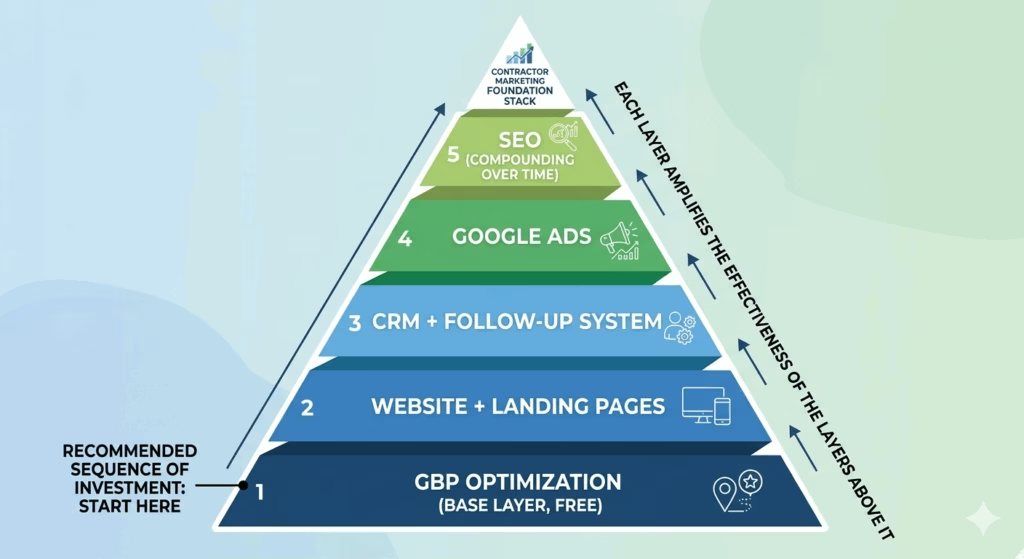
The real answer to “GBP vs. Google Ads” isn’t either/or. It’s both in the right sequence, at the right investment level, with the right infrastructure connecting them.
The market-leading contractors in most local markets are running:
- A fully optimized Google Business Profile with 50–200+ reviews, consistent photo uploads, regular Google Posts, and an active Q&A section generating 20–50+ free leads per month from Local Pack visibility
- Well-managed Google Ads campaigns that capture the high-intent traffic that the GBP doesn’t reach newer searchers, buyers in adjacent zip codes, specific service queries that GBP hasn’t ranked for yet adding another 15–30 leads per month
- A website with dedicated service landing pages that converts the traffic from both channels efficiently
- A CRM and follow-up system that ensures every lead from both channels is captured, responded to immediately, and followed up consistently until they book or opt out
- An SEO strategy that builds long-term organic rankings so that over 18–24 months, the reliance on paid ads decreases as organic traffic grows
This is the full stack. You don’t build it all on day one. But understanding the destination helps you build toward it intentionally rather than reactively.
A comprehensive SEO and digital marketing strategy for contractors coordinates all of these layers — so GBP, ads, website, and SEO are working together rather than as disconnected tactics each fighting for the same budget.
Your Decision Guide: Which Should You Invest in First?
Use this framework to determine the right starting point for your business:
Start with GBP if:
- Your GBP is unclaimed, incomplete, or has fewer than 20 reviews
- You have a modest marketing budget and need to maximize free lead generation before adding paid spend
- Your market is low-to-moderate competition and organic Local Pack visibility is achievable in 60–90 days
- You have time to invest in building a long-term asset rather than needing leads in the next two weeks
Start with Google Ads if:
- You’re a brand-new business with no reviews and need revenue immediately
- You’re in a highly competitive market where the Local Pack is dominated by established businesses
- You have a specific, short-term revenue gap to fill
- Your GBP is already optimized and you’re ready to layer in paid amplification
Run both simultaneously if:
- Your budget supports it ($1,500+/month total for both channels)
- You have a website capable of converting paid traffic
- You have a CRM and follow-up system that ensures leads don’t fall through the cracks
- You’re in a growth phase and want to accelerate market share capture while your organic presence builds
The Bottom Line
Google Business Profile is not a consolation prize for contractors who can’t afford Google Ads. It’s a fundamentally different tool one that builds a permanent, compounding local marketing asset at zero cost, and that actively makes your paid advertising more effective when both are running.
For most contractors, the path is clear: optimize GBP first, build the review volume that makes your entire Google presence more credible and more competitive, then layer in Google Ads as the growth accelerant once the foundation is solid.
The contractors who get this sequence right don’t just generate more leads. They generate better leads, at lower cost, with a competitive position that gets harder to displace every month they continue to invest in it.
Why Schedule a Call?
Popular Insights
How to Use Video to Book More Jobs as a Roofer or Builder (Even If You Hate Being on Camera)
Jul. 31, 2026The Anatomy of a High-Converting Contractor Website: What Customers Actually Look for Before Calling
Jul. 24, 2026
Seasonal Marketing: How Smart Contractors Stay Busy in the Slow Season
Jul. 17, 2026
What Does a $1,500/Month Marketing Budget Actually Get a Shed or Construction Business?
Jul. 10, 2026
DIY vs. Agency: Should a Roofing Company Handle Their Own Marketing?
Jul. 03, 2026Topics

Pudgy Squirrel Marketing
How to Use Video to Book More Jobs as a Roofer or Builder (Even If You Hate Being on Camera)
Read More
Pudgy Squirrel Marketing
The Anatomy of a High-Converting Contractor Website: What Customers Actually Look for Before Calling
Read More
Pudgy Squirrel Marketing
Seasonal Marketing: How Smart Contractors Stay Busy in the Slow Season
Read More
Pudgy Squirrel Marketing
What Does a $1,500/Month Marketing Budget Actually Get a Shed or Construction Business?
Read More
Pudgy Squirrel Marketing
DIY vs. Agency: Should a Roofing Company Handle Their Own Marketing?
Read More
Pudgy Squirrel Marketing
7 Signs Your Construction Company’s Website Is Losing You Jobs (And How to Fix It)
Read More
Pudgy Squirrel Marketing
Google Business Profile vs. Google Ads: Which One Should a Contractor Invest in First?
Read More
Pudgy Squirrel Marketing
How Much Should a Roofing or Construction Company Spend on Marketing? (A No-BS Breakdown)
Read More