Get In Touch
Pudgy Squirrel Marketing
DIY vs. Agency: Should a Roofing Company Handle Their Own Marketing?
By Tony
July 3, 2026
10 mins
Share:
Key Takeaways
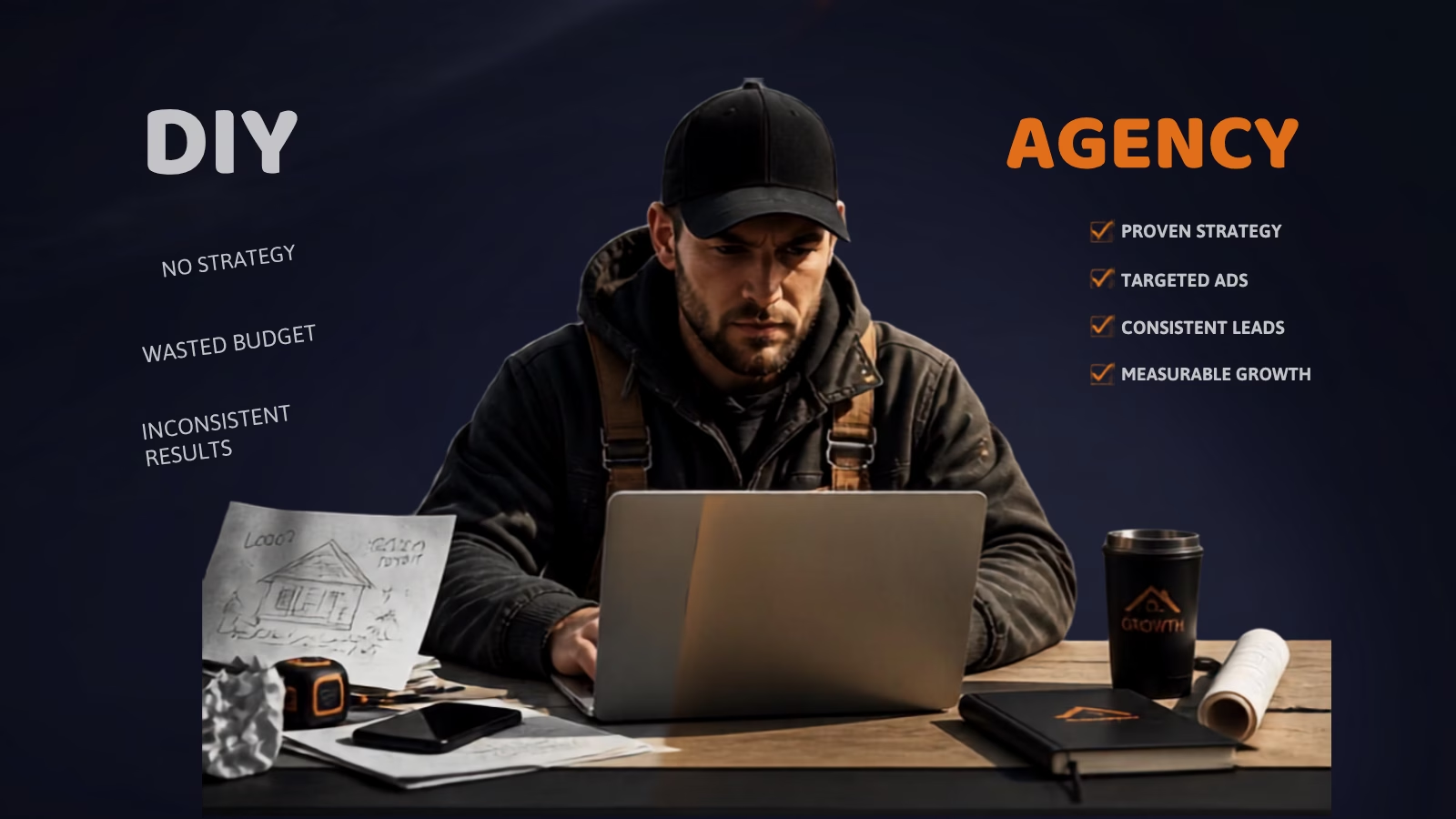
- DIY marketing is not automatically cheaper than hiring an agency when the true cost of your time is factored in, the math often reverses entirely.
- There are specific situations where DIY marketing is the right call, and specific situations where it’s actively holding a roofing business back. Knowing which applies to you is the most important decision in this conversation.
- The biggest hidden cost of DIY marketing isn’t money it’s the opportunity cost of a business owner spending 10–15 hours per week on marketing tasks instead of running and growing the business.
- A general marketing agency and a construction/roofing-specialist agency are not the same thing. The learning curve a generalist agency has to climb before they understand your buyers, your seasonality, and your competitive landscape costs real money and time.
- Hybrid approaches handling some marketing in-house while outsourcing the highest-skill or highest-time-cost functions often represent the best of both worlds for growing roofing companies.
- The right answer depends on four variables: your current revenue, the time you can realistically commit, your in-house skill level, and how aggressively you need to grow.
The Question Every Growing Roofing Company Hits Eventually
Business is going well enough that you’re thinking seriously about marketing for the first time. Or marketing hasn’t been working and you’re wondering whether to take it back in-house or hand it off entirely. Or you’ve been doing it yourself for two years and you’re not sure if you’re getting everything you could out of it.
Whatever brought you to this question, it’s the right one to be asking because the answer has a direct impact on your revenue, your time, and your sanity.
The honest version of this article does something most marketing agency content never does: it tells you when DIY is actually the better choice. Because for some roofing companies, at some stages, it is.
And it tells you clearly when it isn’t.

The True Cost of DIY Marketing (Most Contractors Underestimate It)
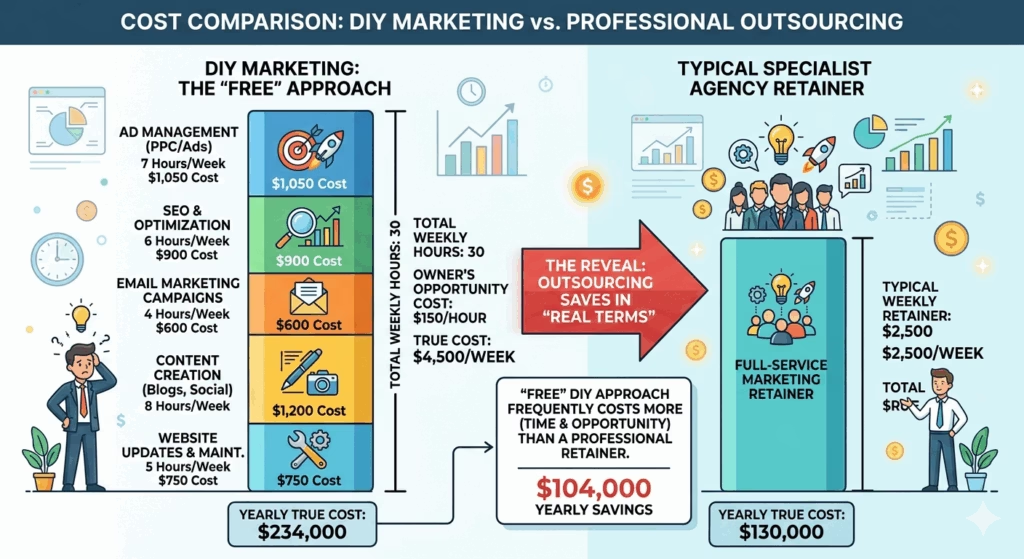
When contractors decide to handle their own marketing, they typically think of the cost in terms of dollars saved: no agency retainer, no monthly fees, just sweat equity.
This calculation almost always misses the most significant cost on the ledger: your time.
Here’s what DIY marketing for a roofing company actually requires if done at a meaningful level:
Content creation: Writing blog posts, creating Facebook and Instagram content, filming videos, editing project photos 4–6 hours per week minimum for a consistent, quality presence.
Google Ads management: Keyword research, ad copy writing, landing page testing, bid adjustments, negative keyword management, conversion tracking, and monthly performance reviews 3–5 hours per week for a campaign that’s actually being optimized rather than just running.
SEO: On-page optimization, content strategy, local citation building, Google Business Profile management, internal linking 3–5 hours per week for meaningful progress.
Email and CRM: Setting up and maintaining follow-up sequences, segmenting leads, reviewing response rates, updating automations 2–3 hours per week.
Analytics and reporting: Understanding what’s working, what isn’t, and making informed decisions about where to invest 2–3 hours per week.
Add it up and you’re looking at 14–22 hours per week of legitimate marketing work for a roofing company trying to compete effectively in a mid-size market.
Now apply your hourly value to that time.
If your time as the business owner bidding jobs, running crews, managing relationships, making operational decisions is worth $150/hour conservatively, then 15 hours per week of marketing tasks costs you $2,250 in opportunity cost. Every week. That’s $9,000 per month of time value being redirected from your highest-leverage activities to marketing execution.
For most roofing companies, a specialist agency costs less than that and produces better results because the people doing the work do it full-time.
This isn’t an argument that DIY is always wrong. It’s an argument that the true cost of DIY is almost always higher than it appears on the surface.
Where DIY Marketing Actually Makes Sense
Despite the above, there are real situations where handling your own roofing marketing fully or partially is the right call.
You’re in the Very Early Stage ($0–$200K Revenue)
When you’re just starting out, cash is the constraint. You may genuinely not have the budget for a full-service agency, and some basic marketing tasks done adequately in-house are better than no marketing at all.
At this stage, focus your DIY energy on the highest-leverage, lowest-cost activities:
- Fully setting up and optimizing your Google Business Profile (free, high-impact)
- Taking and publishing quality project photos after every job
- Asking every satisfied customer for a Google review
- Posting consistently to Facebook three times per week
These are activities that don’t require deep expertise, produce real results, and can be done in under five hours per week if you’re disciplined about it. Save the agency relationship for when revenue justifies it.
You or Someone on Your Team Has Genuine Marketing Skill
If you have a family member, a part-time employee, or a personal background in digital marketing SEO, paid ads, social media management it changes the calculation significantly.
An in-house person who knows Google Ads, understands SEO fundamentals, and can build effective landing pages is a real asset. The key question is whether that person has the time to execute consistently and the depth to keep up with algorithm changes, platform updates, and evolving best practices.
One caveat: “I’ve boosted a few Facebook posts” is not the same as knowing how to run a properly structured Google Ads campaign. Overestimating in-house capability is one of the most common and expensive DIY marketing mistakes.
Your Market Is Low-Competition and Organic Visibility Is Already Strong
If you’re operating in a smaller market where your Google Business Profile already ranks in the top three without heavy optimization, you’re getting consistent organic leads, and your competitors aren’t running sophisticated digital campaigns the marginal return of an agency may not justify the cost.
In this situation, maintaining what’s working with disciplined DIY effort is entirely reasonable. Focus on keeping your GBP active, your reviews flowing, and your website current.
You Have the Time and Enjoy the Learning Curve
Some roofing business owners genuinely enjoy the marketing side of things. If you find it energizing, have the discipline to stay consistent, and have the time to invest in learning DIY can work. Just be honest with yourself about whether it’s actually getting done at a quality level that moves the needle, or whether it’s something you intend to do but deprioritize when the job site gets busy.
Where DIY Marketing Breaks Down for Roofing Companies
The Consistency Problem
The most common failure mode in DIY roofing marketing is not incompetence it’s inconsistency.
Spring comes. You’re slammed. Marketing falls apart. Posts stop. Blog updates stop. Google Ads campaigns run on autopilot with no optimization. Leads coming in from organic are untracked. The momentum built over six months of consistent effort erodes in six weeks of neglect.
Then things slow down in November. You try to restart, but the algorithm penalizes the gap. The reviews you should have been collecting all summer didn’t get asked for. The SEO work that needed monthly maintenance fell behind.
Marketing only compounds when it’s consistent. The moment it becomes reactive something you do when you have time rather than something that runs regardless of how busy you are you’re losing the compounding benefit that makes it valuable in the first place.
An agency doesn’t have a slow season. The work continues at the same pace whether you’re completing 15 jobs a week or 3.
The Expertise Gap
Roofing is a skilled trade. Digital marketing is a skilled trade. Expecting one person especially one primarily occupied with running a construction business to execute both at a high level is asking for the kind of generalist competence that typically produces generalist results.
Google Ads specifically is a discipline where the gap between a competent practitioner and an amateur is measured in thousands of dollars per month. A poorly structured campaign wrong keyword match types, no negative keyword list, broad targeting, no conversion tracking, sending traffic to the homepage instead of a landing page can burn through $2,000–$3,000 per month and produce almost no booked jobs.
A well-managed campaign with the same budget, run by someone who does this full-time, produces a measurably different outcome.
The same applies to SEO. The technical and strategic knowledge required to move a roofing company’s website from page three to page one for competitive local keywords is not casual knowledge. It’s accumulated through hundreds of hours of study and implementation across dozens of campaigns.
The Attention Problem
This is the most honest conversation in the DIY vs. agency debate: marketing requires undivided attention to do well, and a roofing business owner’s attention is already the most competed-for resource in the entire operation.
Crew issues, material delays, weather changes, customer callbacks, quote requests, invoicing, HR situations all of these compete with marketing for the same finite pool of attention. And in a roofing business, the job site almost always wins. As it should.
The jobs that fall through the cracks in DIY marketing aren’t the ones the business owner decided to deprioritize. They’re the ones that got crowded out by urgent operational demands. And the business never knows what it’s missing.
The Agency Option: What to Look For (And What to Avoid)
If the case for an agency resonates, the next question is how to choose one and what separates an agency that produces results from one that produces invoices.
Industry Specialization Matters More Than You Think
A roofing company’s marketing has specific characteristics that a generalist agency has to learn from scratch: the seasonal demand pattern, the storm-chasing dynamic, the insurance claim process, the homeowner psychology around a high-stakes purchase, the local competitive landscape, and the specific search behavior of buyers in different stages of the roofing decision.
An agency that has never worked with a contractor before will spend the first three to six months learning your industry. You’re paying for that education.
An agency that specializes in construction, roofing, and trade businesses the way Pudgy Squirrel Marketing does already speaks your language, understands your buyer, and has tested what works in your category across multiple clients. The learning curve is dramatically compressed, and the strategy is built on actual industry experience rather than generic digital marketing principles applied to a new vertical.
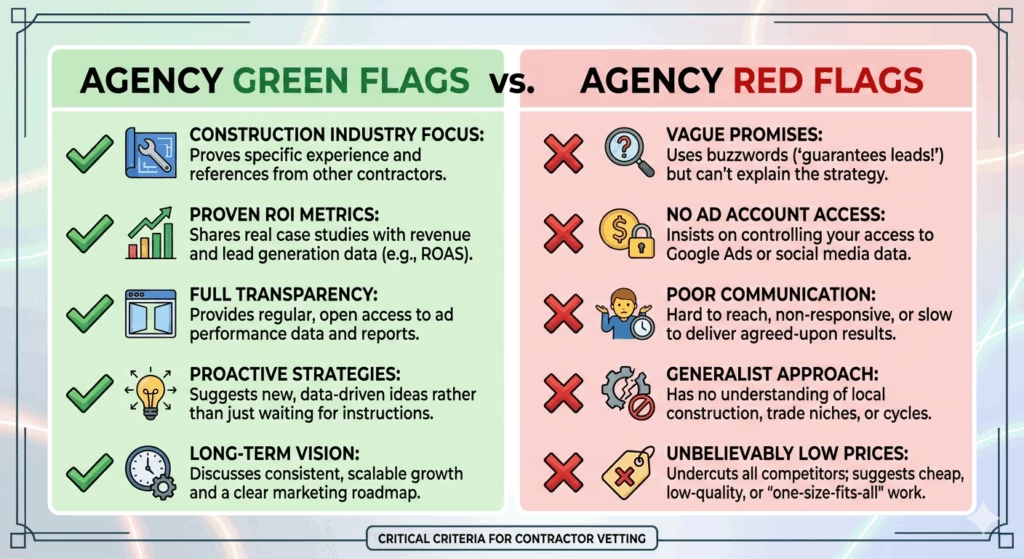
Green Flags When Evaluating an Agency
- Can they show you specific results from other roofing or construction clients? (Real data lead volume, cost per lead, ranking improvements not vague success stories)
- Do they understand your specific service area and competitive landscape, or are they pitching a generic package?
- Can they explain their strategy in plain language without hiding behind jargon?
- Are they asking about your business goals, your margins, and your capacity or just trying to close the deal?
- Do they provide monthly reporting that ties marketing activity to actual business outcomes (leads, booked jobs, revenue)?
Red Flags to Walk Away From
- Promises of guaranteed #1 Google rankings (no one can guarantee this search ranking is determined by Google’s algorithm, not by an agency’s effort)
- Long-term contracts with no performance milestones or exit clauses
- Agencies that want to control your website, your Google accounts, or your GBP without giving you access if you leave, you should be able to take your assets with you
- No clear attribution model if they can’t tell you how many leads their work generated, they can’t demonstrate value
- Cookie-cutter packages with no customization to your market, your services, or your growth stage
What a Specialist Agency Should Provide for a Roofing Company
A roofing-specific marketing partner should be able to deliver an integrated system — not a collection of disconnected tactics:
- A conversion-optimized website with dedicated service pages that ranks for local service keywords and converts visitors into estimate requests
- An SEO strategy that builds organic Local Pack visibility and long-term first-page rankings for your highest-value service keywords
- Google Ads campaigns structured to generate high-intent leads at a profitable cost-per-acquisition, with landing pages designed to convert
- A CRM and follow-up automation system that ensures every lead is captured and followed up on systematically
- Monthly reporting that connects marketing activity to real business metrics leads, booked jobs, and revenue generated
If an agency can’t deliver these as a coherent system if they’re just running ads or just doing social media without connecting it to conversion infrastructure you’re buying a piece of the solution at the full price of the whole thing.
The Hybrid Approach: Often the Best of Both Worlds
Binary thinking either fully DIY or fully outsourced misses a middle path that works very well for many roofing companies in the $500K–$2M revenue range.
The hybrid approach means:
Handle in-house:
- Project photos (you’re already on the job site)
- Facebook and Instagram posts using your own photos and job updates
- Google review requests from satisfied customers
- Basic Google Business Profile updates (new photos, responding to reviews)
Outsource to specialists:
- Website design and technical SEO (high skill requirement, one-time or periodic investment)
- Google Ads campaign management (high skill requirement, ongoing optimization)
- Content strategy and blog writing (time-intensive, requires marketing expertise)
- CRM setup and automation (technical setup, then minimal maintenance)
- Monthly strategy and performance review (objective third-party perspective)
This split captures the authentic, local content that performs best on social media (your actual projects, your actual team) while delegating the technical and time-intensive work that produces the biggest ROI gap between expert execution and amateur execution.
The result is often a lower total cost than full agency management, better social content than a remote agency can produce, and better technical marketing performance than most owners can achieve in-house.
The Decision Framework: Which Is Right for Your Roofing Company?
Use these five questions to determine the right approach for where your business is right now.
Question 1: What is your current annual revenue?
- Under $300K → DIY or hybrid with minimal agency spend
- $300K–$800K → Hybrid, or agency for specific high-impact functions (ads, website, SEO)
- $800K+ → Full-service specialist agency typically produces the best ROI
Question 2: How many hours per week can you genuinely commit to marketing?
- 10+ hours → DIY may work if skill level is adequate
- 4–9 hours → Hybrid is likely the most realistic approach
- Under 4 hours → Agency is the appropriate choice you don’t have the bandwidth for meaningful DIY execution
Question 3: What is your honest skill level in each marketing area? For each area below, rate yourself: Expert / Competent / Beginner
- Google Ads: ____
- SEO: ____
- Website / landing page design: ____
- Social media content: ____
- Email marketing and CRM: ____
- Analytics and reporting: ____
Outsource any area where you rated yourself Beginner. Be honest Beginner execution in Google Ads costs you real money every month.
Question 4: How aggressively do you need to grow in the next 12 months?
- Maintenance mode → DIY for lower-cost owned channels (GBP, social, reviews)
- Moderate growth (10–25%) → Hybrid with agency support on highest-leverage channels
- Aggressive growth (25%+) → Full-service specialist agency to maximize speed and quality
Question 5: Have you tried DIY for more than 6 months with consistent effort? If yes: What were the results? Did lead volume grow measurably? Did conversion rates improve? If not and the effort was genuine and consistent the gap is likely a skills and expertise issue that warrants professional support.
If no: Try the hybrid approach for 60–90 days with honest commitment before concluding it doesn’t work. Inconsistent DIY attempts are not a fair test of what in-house marketing can do.
The Honest Conclusion Most Marketing Content Never Gives You
Here it is: some roofing companies should do their own marketing, at least for now.
If you’re early stage, cash-constrained, and willing to put in the hours on the highest-leverage free channels GBP optimization, consistent project photos, review generation you can build a meaningful foundation without agency support. Do that first.
If you’re past the early stage, have tried consistent DIY for six or more months, and your lead volume and conversion rates aren’t reflecting the effort you’re putting in that’s a signal. The returns on disciplined DIY effort should be measurable. If they’re not, the issue is likely expertise or strategy, not effort.
And if your time is already maxed out managing a growing operation if marketing is the thing that always gets pushed to tomorrow the ROI calculation on an agency is usually obvious once you factor in what your time is actually worth.
The contractors who grow fastest are rarely the ones who try to do everything themselves. They’re the ones who identify the highest-leverage uses of their personal time and ruthlessly delegate everything else.
Marketing, for most roofing company owners past the startup stage, belongs in the second category.
Why Schedule a Call?
Popular Insights
The Shed Dealer’s Digital Playbook: How to Get Found Online and Fill Your Lot
Aug. 21, 2026
The Shed Business Owner’s Blueprint for Getting Found on Google
Aug. 14, 2026
Why Your Roofing Website Gets Traffic But No Phone Calls (And How to Fix It)
Aug. 07, 2026How to Use Video to Book More Jobs as a Roofer or Builder (Even If You Hate Being on Camera)
Jul. 31, 2026The Anatomy of a High-Converting Contractor Website: What Customers Actually Look for Before Calling
Jul. 24, 2026Topics
Pudgy Squirrel Marketing
The Shed Dealer’s Digital Playbook: How to Get Found Online and Fill Your Lot
Read More
Pudgy Squirrel Marketing
The Shed Business Owner’s Blueprint for Getting Found on Google
Read More
Pudgy Squirrel Marketing
Why Your Roofing Website Gets Traffic But No Phone Calls (And How to Fix It)
Read More

Pudgy Squirrel Marketing
How to Use Video to Book More Jobs as a Roofer or Builder (Even If You Hate Being on Camera)
Read More
Pudgy Squirrel Marketing
The Anatomy of a High-Converting Contractor Website: What Customers Actually Look for Before Calling
Read More

Pudgy Squirrel Marketing
Seasonal Marketing: How Smart Contractors Stay Busy in the Slow Season
Read More
Pudgy Squirrel Marketing
What Does a $1,500/Month Marketing Budget Actually Get a Shed or Construction Business?
Read More
Pudgy Squirrel Marketing
DIY vs. Agency: Should a Roofing Company Handle Their Own Marketing?
Read More