
Get In Touch
Pudgy Squirrel Marketing
The Amish and Plain Community Business Owner’s Guide to Online Marketing
By Tony
October 2, 2026
13 mins
Share:
Key Takeaways
- Amish and Plain community businesses have a built-in credibility advantage that most competitors cannot replicate. The challenge is not quality. It is visibility.
- You do not need to personally manage or even touch the internet for your business to benefit from it. A trusted marketing partner can handle every digital touchpoint on your behalf.
- The highest-priority channels for Plain community businesses are Google Business Profile, a simple professional website, and targeted local SEO.
- Word-of-mouth is powerful but geographically limited. Online marketing extends your reach far beyond the communities that already know you.
- Direct mail and digital marketing work especially well together for Amish-owned businesses, since mailers can drive customers to a website or phone number managed by a partner.
- Your values of honesty, craftsmanship, and reliability are marketing assets. A good strategy amplifies what you already are.
Introduction: The World Is Searching for What You Build. Can They Find You?
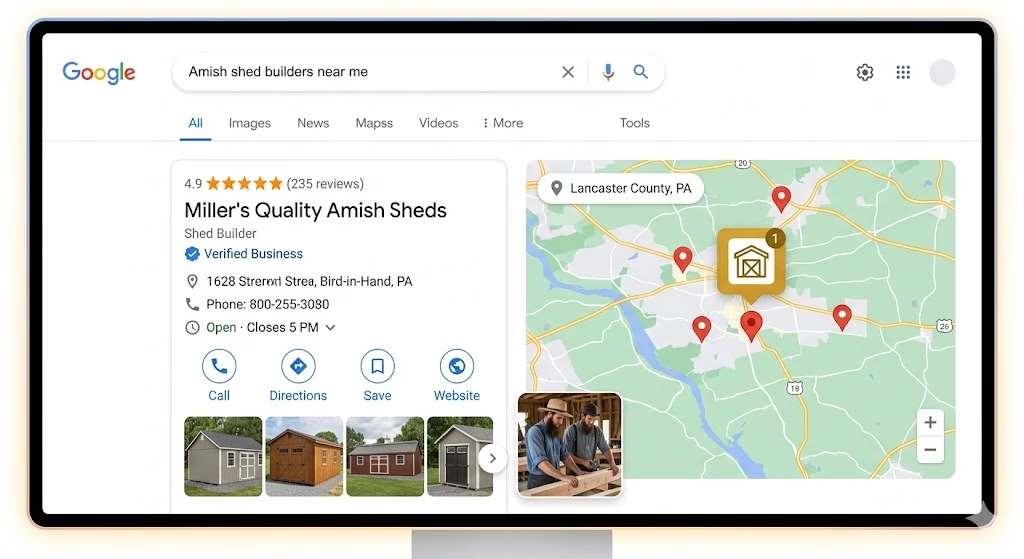
Every day, thousands of people type searches like “Amish shed builders near me,” “plain community furniture makers,” “Amish construction crew [state],” and “handcrafted wood buildings for sale” into Google.
These are buyers. They are specifically looking for what Amish and Plain community craftsmen and business owners are known for: honest work, exceptional quality, fair pricing, and the kind of reliability that has become rare in the broader marketplace.
The problem is not the demand. The demand is strong and growing. The problem is that many of the best craftsmen and business owners in Plain communities are difficult or impossible to find online, so that demand flows to competitors who may offer far less in terms of actual quality and integrity.
This guide is written specifically for Amish and Plain community business owners, or for the English managers, family members, or marketing partners who help run the business side on their behalf. It covers the specific strategies that work best for this community, addresses the practical and doctrinal considerations around technology use, and gives you a clear, honest picture of what online marketing can and cannot do for your business.
Understanding the Unique Opportunity for Plain Community Businesses
Before getting into tactics, it is worth naming the marketing advantage that Amish and Plain community businesses carry into every customer interaction.
In a marketplace where homeowners are frequently burned by contractors who overpromise, underdeliver, cut corners, and disappear after a problem arises, the reputation of the Amish and Plain community trades carries enormous weight. Surveys of homeowners consistently show that “Amish-built” or “Plain community craftsmanship” is treated as a quality signal in the same way that consumers associate certain regions with premium wine or certain brands with premium goods.
That reputation is not manufactured. It is earned over generations. And it is a genuine competitive advantage that most digital-age competitors simply cannot match.
The opportunity in online marketing is to make that reputation findable. Right now, much of the demand for Amish craftsmanship travels through word-of-mouth within networks that are already aware of Plain community businesses. That is valuable, but it is also a ceiling.
When a family in a neighboring state is looking for a quality shed builder, a furniture craftsman, or a reliable construction crew, they may have no connection to those existing word-of-mouth networks. They search Google. If your business is not there, you do not exist to them.
Online marketing does not change who you are. It makes who you are visible to people who are actively looking for exactly what you offer.
A Practical Note on Technology and Plain Community Values
Different Plain communities have different guidelines around technology, and those guidelines vary significantly by district, affiliation, and individual bishop or elder decisions. This guide does not advocate for any position on those internal community discussions.
What is worth noting practically is this: a business owner does not need to personally use the internet, own a smartphone, or interact with any digital platform for their business to benefit from online marketing.
Many Amish and Plain community businesses are already structured this way. An English employee, a family member outside the community, an office manager, or a hired marketing agency handles all digital touchpoints. The business owner provides the information, photos, and approvals through whatever communication methods are appropriate to their situation, and the marketing partner executes everything else.
This is not a compromise. It is a practical division of labor, similar to hiring an accountant to handle bookkeeping or an attorney to handle contracts. The craftsman builds. The partner handles the digital tools that bring customers to the craftsman.
If you are reading this as a family member, office manager, or marketing partner supporting an Amish or Plain community business, the rest of this guide is structured with your role in mind as well as the business owner’s.
Section 1: Your Google Business Profile Is the Most Important First Step
If a Plain community business could only do one thing online, it should be this: claim and fully optimize a Google Business Profile.
A Google Business Profile (GBP) is the business listing that appears in Google Maps and in the local search results box when someone searches for services near them. It shows your business name, location, phone number, hours, photos, services, and customer reviews.
It is free to create and manage. It does not require a website. And it is the single highest-leverage digital touchpoint available for local businesses.
What a Fully Optimized Google Business Profile Includes
Accurate business name, address, and phone number. These must be consistent and correct. If your business operates from a rural address or a P.O. Box, work with your marketing partner to determine the best listing format for your situation.
Business category. Choose the most specific and accurate primary category. “Shed Builder,” “Furniture Store,” “General Contractor,” “Barn Builder,” or “Cabinet Maker” are all available options. The right category determines which searches your profile appears in.
Service list. Add every service you offer as individual entries in the Services section. The more specific and complete this list is, the more search queries your profile can match.
Photos. This is where Plain community businesses have an extraordinary opportunity. Real photos of real craftsmanship, completed buildings, furniture pieces, barns, or construction projects stop the scroll in a way that competitor profiles filled with stock images simply cannot. A marketing partner can handle uploading and managing photos on the business owner’s behalf using images provided by the business.
Customer reviews. Google reviews are the most powerful trust signal in local search. A Google Business Profile with 50 five-star reviews will outrank and outconvert a competitor with 5 reviews, almost every time. Encouraging satisfied customers to leave reviews, and having a system for requesting them consistently, is one of the highest-ROI activities in local marketing.
Business description. A 750-character description that naturally incorporates key search terms (such as the type of work, the service area, and any community identity that is accurate and relevant) helps Google understand what the business does and who it serves.
Posts. Posting updates, completed project photos, or seasonal promotions directly to the GBP keeps the profile active and signals to Google that the business is engaged.
Section 2: A Simple, Professional Website Builds Credibility and Captures Leads
A Google Business Profile gets people to notice you. A website gives them a place to learn more and take action.
Many potential customers, especially those coming from outside the immediate area, will want to see a website before they call. A professional website communicates that the business is established, organized, and worth contacting. The absence of a website, for customers who are not already connected to your community networks, can be a reason not to call.
The good news is that an effective website for a Plain community business does not need to be complicated. It needs to do a small number of things well.
What an Effective Website for a Plain Community Business Includes
A clear description of what you do and where you do it. The homepage should communicate your primary service and your service area within the first few seconds of a visitor arriving. “Custom Shed Building Serving Pennsylvania, Ohio, and Indiana” is an immediate, clear statement of value.
Real photography of completed work. As with the Google Business Profile, real photos of actual projects are the single most persuasive element on a contracting or craftsmanship website. A gallery of completed sheds, furniture pieces, barns, or buildings does more marketing work than any headline.
A clear way to contact you. A phone number, prominently displayed. A simple contact form. A call-to-action button on every page. The website’s job is to convert visitors into inquiries. Everything should point toward that outcome.
Your service area. If you serve customers within a certain radius or across certain states, say so explicitly. This helps both visitors and Google understand who the business is for.
Social proof. Customer testimonials, review excerpts from Google, and any relevant credentials or affiliations build trust for visitors who are making a decision about an unfamiliar business.
Basic local SEO. The website should include the geographic areas you serve, naturally woven into page content, headings, and page titles. This is what allows the site to rank in search results for location-specific queries.
A professionally designed website built for your industry is one of the most important investments a growing Plain community business can make. It works 24 hours a day, requires no ongoing personal involvement from the business owner, and serves as the foundation for every other marketing channel.
Section 3: Local SEO Puts You in Front of Buyers Who Are Actively Searching
Having a Google Business Profile and a website is a start. Local SEO is what makes them show up when the right people are searching.
Local SEO is the process of optimizing your online presence so that your business appears prominently in search results when potential customers in your area search for what you offer.
For a Plain community shed builder in Lancaster County, Pennsylvania, local SEO means showing up when someone searches “shed builders Lancaster County PA” or “Amish shed builders Pennsylvania.” For a furniture maker in Holmes County, Ohio, it means ranking for “custom Amish furniture Ohio” or “handcrafted wood furniture Holmes County.”
The Core Local SEO Priorities for Plain Community Businesses
Consistent business information across the web. Your business name, address, and phone number should be identical on every website where you are listed. Inconsistencies across directories confuse search engines and can suppress your rankings.
Location-specific content on your website. A website that specifically mentions the counties, cities, and states you serve will rank for searches in those areas. If you serve customers across multiple states, consider individual pages for each primary region.
Google review volume and recency. Reviews on your Google Business Profile are a significant local ranking factor. A consistent system for requesting reviews from satisfied customers, managed by your English partner or office staff, compounds significantly over time.
Backlinks from relevant local sources. When other websites link to yours, it signals authority to Google. Chamber of commerce listings, local business directories, industry associations, and any community organizations that list member businesses are good starting points.
Accurate category and attribute settings on your GBP. Selecting the right primary and secondary business categories, and completing all available attribute fields on your Google Business Profile, helps Google match your listing to relevant searches.
An SEO strategy designed around your specific trade and service area is what separates businesses that occasionally appear in search results from ones that consistently dominate them. For Plain community businesses with strong reputations and excellent reviews, the underlying quality is already there. SEO is what makes that quality visible at scale.
Section 4: Direct Mail Is a Natural Fit for Plain Community Marketing
For many Amish and Plain community businesses, direct mail feels more familiar and more comfortable than digital advertising. It is also, in many cases, one of the highest-performing marketing channels available, particularly when used in combination with a web presence.
A well-designed mailer can drive homeowners to call a phone number managed by your office or marketing partner, visit a website that your partner maintains, or contact you through whatever method works best for your operation.
Why Direct Mail Works Especially Well for Plain Community Businesses
It reaches people who are not yet searching online. A mailer lands in front of homeowners who may not know to search for “Amish shed builders” because they have not yet thought of it. The mailer puts the idea in front of them at the right moment.
It is a physical, tangible object. In the same way that Plain community craftsmanship is physical and tangible, a well-made mailer is held, looked at, and often kept. A homeowner planning a shed project may hold onto a mailer for weeks before calling.
It leverages your reputation directly. Including language like “Amish-built quality,” “plain community craftsmanship,” or “handcrafted by [community] builders” on a mailer activates the trust associations that buyers already have with those descriptors.
It is manageable without personal technology use. The business owner provides information and approves the design through whatever communication method is appropriate. The printing, addressing, and mailing is entirely handled by the marketing partner.
The neighbor effect. When your crew completes a job in a neighborhood, a mailer to the surrounding 100 to 200 homes with a photo of the completed project and a mention of the nearby job is one of the highest-converting formats in the trades. People trust what they can see.
A targeted mailer campaign designed for your trade and service area can work as a standalone channel or as a complement to your digital presence, driving interested homeowners to your website or phone number and creating multiple touchpoints before a customer decides to call.
Section 5: Managing Reviews Without Managing Technology
Customer reviews are the digital equivalent of word-of-mouth. For a business that has always relied on reputation and referrals, the parallel is direct.
When a potential customer searches for a shed builder or furniture maker in your area and sees that your business has 80 five-star reviews, many of them from people who specifically mention the quality of the craftsmanship, the professionalism of the crew, and the honest pricing, that is more persuasive than any advertisement you could run.
The challenge for many Plain community businesses is that asking for and managing reviews requires interaction with digital platforms. Here is how to handle that practically.
A Simple Review System That Requires No Personal Tech Use
Step 1: At the completion of every job, a designated English employee, family member, or office manager asks the customer in person or by phone if they would be willing to leave a Google review. A simple script makes this easy: “We really appreciate your business. If you had a good experience, we would be grateful if you left us a quick Google review. Would it be okay if we texted or emailed you a link to make that easy?”
Step 2: The designated team member sends the customer a direct link to the Google review form. Google provides a short link for every Business Profile that goes directly to the review submission page.
Step 3: When reviews are posted, the designated team member reads them to the business owner (if desired) and posts a brief, personal response on behalf of the business. Responses do not need to be long. A simple “Thank you for trusting us with your project. We are glad it turned out well” is appropriate and appreciated.
Step 4: Track review count and average rating over time. Set a goal of receiving at least two to four new reviews per month. Over a year, that is 24 to 48 new reviews, each one building credibility for the next potential customer who finds you.
Section 6: What to Look for in a Marketing Partner
Because many Amish and Plain community business owners work through a trusted English partner or marketing agency, the quality of that relationship matters enormously. The right partner understands your values, communicates in ways that work for your situation, and earns trust through transparency and honest results.
Here is what to look for and what to avoid.
Green Flags in a Marketing Partner
- They ask questions about your business, your customers, and your values before recommending any services.
- They communicate clearly about what results are realistic and on what timeline.
- They provide regular, simple reporting that shows what your marketing dollars are producing.
- They have experience working with home services businesses, trades, or construction and understand the buying cycle of your customers.
- They are willing to work within the communication methods that suit your situation, whether that is phone calls, in-person meetings, or working through a designated English contact.
- They treat your community identity and reputation as an asset to be amplified, not as a novelty to exploit.
Red Flags to Watch For
- They promise specific rankings or lead volumes within unrealistically short timeframes.
- They are not transparent about what they are doing or how they are spending your budget.
- They require long-term contracts with no performance accountability.
- They use jargon to obscure what they are actually delivering.
- They do not ask about your business goals before presenting a package.
- They treat every client the same regardless of industry, community, or market.
Section 7: A Practical Starting Point for Different Business Types
The right starting strategy depends on what type of business you run and how far along you are in building a digital presence. Here is a simplified guide by business type.
Shed Builders and Portable Building Dealers
Priority 1: Google Business Profile with complete photo gallery of your building inventory and completed customer installations.
Priority 2: A simple website with a photo gallery, pricing guidance or quote request form, and location pages for each primary market you serve.
Priority 3: Seasonal direct mail campaigns to homeowners in your delivery radius, timed to peak buying seasons (spring and early summer are typically highest volume).
Priority 4: Local SEO to rank for searches like “sheds for sale [county]” and “Amish shed builders [state].”
Furniture Makers and Woodworkers
Priority 1: Google Business Profile with high-quality photos of your furniture and woodworking.
Priority 2: A website with a portfolio gallery, product categories, ordering or quote process, and geographic service information (local pickup, regional delivery, or nationwide shipping as applicable).
Priority 3: Local SEO targeting search terms like “custom Amish furniture [state]” and “handcrafted wood furniture [city or region].”
Priority 4: A consistent review generation system, since furniture buyers research heavily before purchasing.
Construction Crews and Contractors
Priority 1: Google Business Profile with project photos, specific service categories, and a review generation system.
Priority 2: A professional website with project gallery, service descriptions, service area, and an easy quote request process.
Priority 3: Neighbor campaign mailers during active job seasons.
Priority 4: Local SEO for service-specific and location-specific search terms.
Farmers Markets, Food Producers, and Retail Operations
Priority 1: Google Business Profile with accurate hours, location, and product photos.
Priority 2: Local SEO and directory listings to capture “near me” searches from nearby consumers.
Priority 3: A simple website or landing page with location, hours, and product information.
The Honest Timeline: What to Expect and When
Online marketing for local businesses is not an overnight change. Here is an honest picture of what to expect.
Month 1: Google Business Profile created or claimed and fully optimized. Website reviewed or built. Review request system in place. These changes are visible immediately after setup.
Months 2 to 3: Local search rankings begin to improve as Google indexes the optimized profile and website content. Review count starts growing if the request system is running consistently.
Months 4 to 6: Meaningful improvement in local search visibility. Inbound inquiries from Google search and Maps become a measurable part of the business’s lead flow. This is when most businesses begin to see a clear return on their marketing investment.
Months 6 to 12: Compounding returns. Reviews accumulate. Rankings stabilize and strengthen. The website generates consistent organic traffic. Mailer campaigns build brand recognition in target geographies. The marketing system begins to run with minimal active management.
Year 2 and beyond: The gap between businesses with a strong digital presence and those without grows wider. Businesses that invested early hold a structural advantage that is difficult for competitors to close quickly.
The Bottom Line: Your Reputation Deserves to Be Found
Amish and Plain community businesses carry something into the marketplace that decades of advertising cannot manufacture: a genuine reputation for honest work and exceptional quality.
The only thing standing between that reputation and a much larger customer base is visibility. Most of the people who would choose you, given the option, simply do not know you exist.
Online marketing, done respectfully and handled by a trusted partner, closes that gap. It does not change what you do. It makes sure the right people can find you when they are ready to hire someone who does it right.
If you are ready to understand where your business stands online and what the clearest path to greater visibility looks like, the right first step is an honest assessment of your current presence. A free marketing audit gives you a clear picture of what is working, what is missing, and what your competitors are doing that you are not, with no obligation and no pressure.
Why Schedule a Call?
Popular Insights
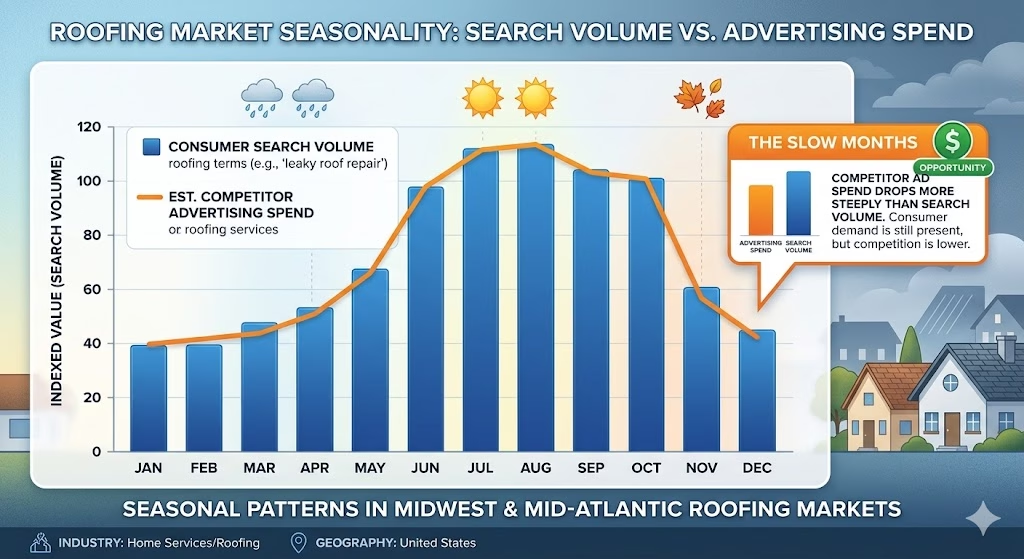
How Roofers Get More Leads in the Off-Season: A Practical Marketing Playbook for Slow Months
Oct. 13, 2026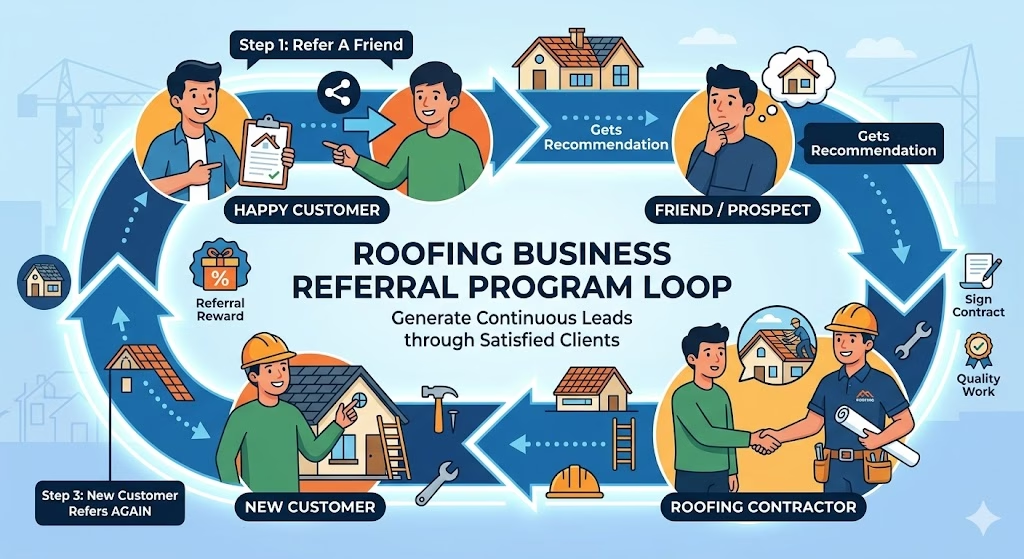
How to Build a Referral Program for Your Roofing or Construction Business (Without Spending a Fortune)
Oct. 09, 2026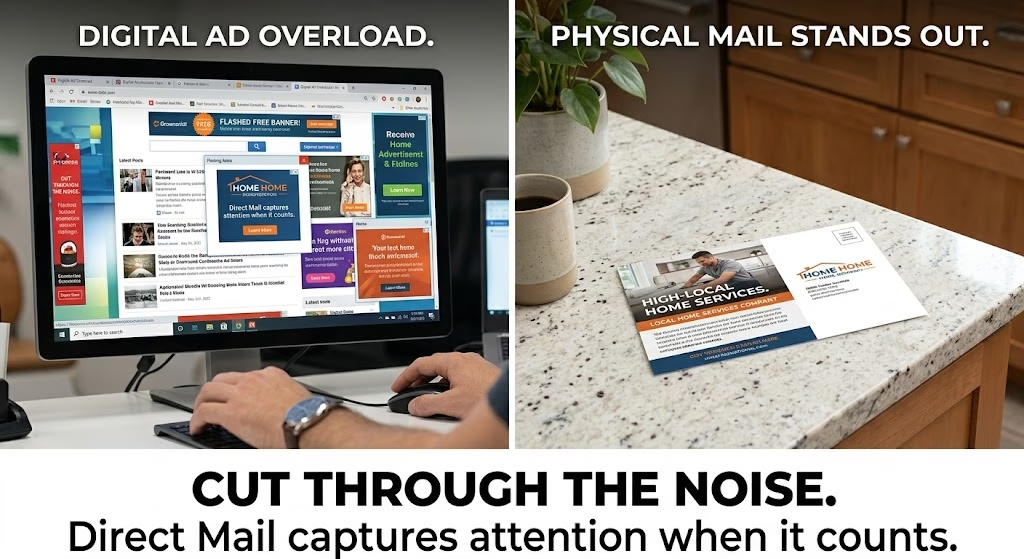
Mailers Aren’t Dead: Why Direct Mail Still Works for Roofing and Construction (And How to Run One That Converts)
Sep. 22, 2026
Storm Season is Coming: How to Market Your Roofing Business Before, During, and After a Major Weather Event
Sep. 18, 2026
Email Marketing for Contractors: The 5 Campaigns That Actually Bring Back Past Customers
Sep. 11, 2026Topics
Pudgy Squirrel Marketing
How Roofers Get More Leads in the Off-Season: A Practical Marketing Playbook for Slow Months
Read More
Pudgy Squirrel Marketing
How to Build a Referral Program for Your Roofing or Construction Business (Without Spending a Fortune)
Read More
Pudgy Squirrel Marketing
The Amish and Plain Community Business Owner’s Guide to Online Marketing
Read More
Pudgy Squirrel Marketing
Mailers Aren’t Dead: Why Direct Mail Still Works for Roofing and Construction (And How to Run One That Converts)
Read More
Pudgy Squirrel Marketing
Storm Season is Coming: How to Market Your Roofing Business Before, During, and After a Major Weather Event
Read More
Pudgy Squirrel Marketing
Email Marketing for Contractors: The 5 Campaigns That Actually Bring Back Past Customers
Read More
Pudgy Squirrel Marketing
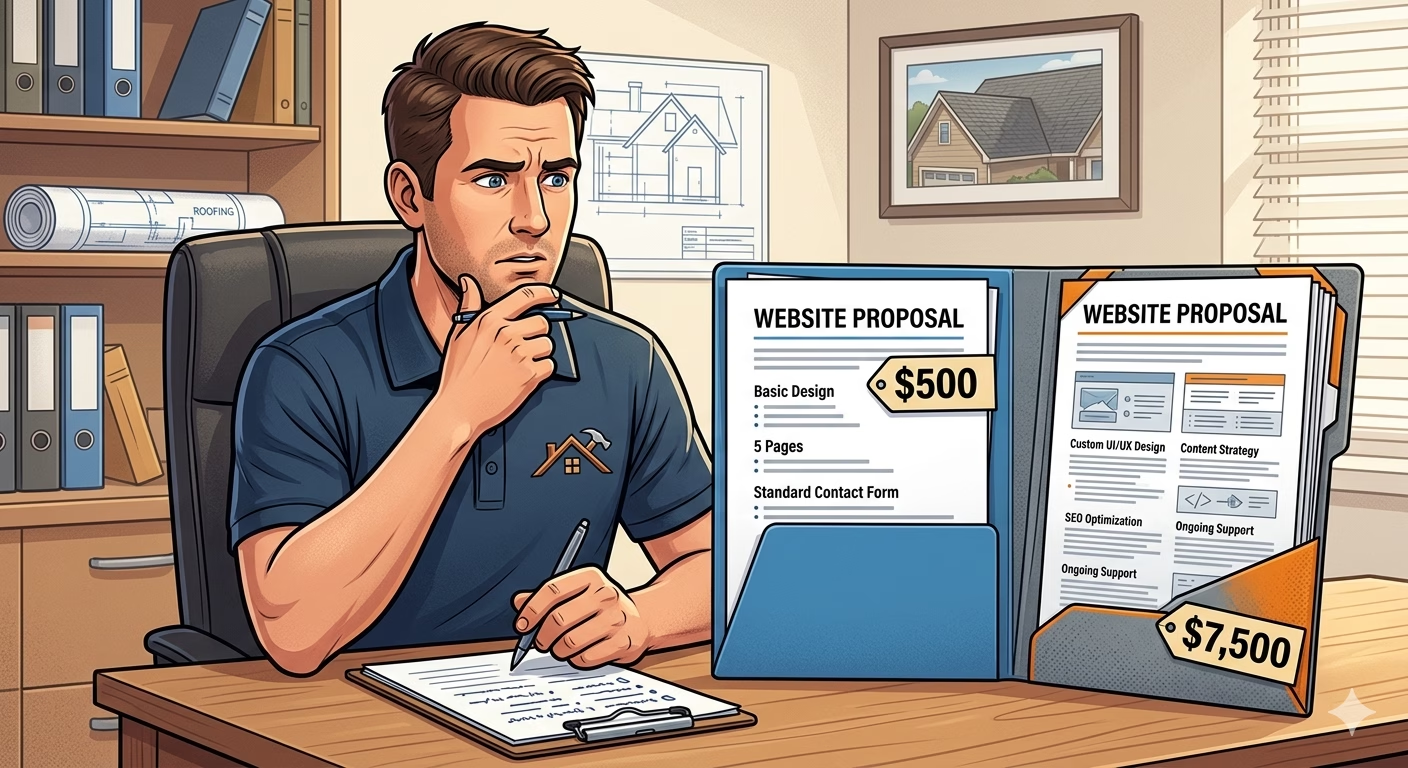
What a Roofing Website Should Cost in 2026 (And What You Actually Get for the Money)
Read More
Pudgy Squirrel Marketing
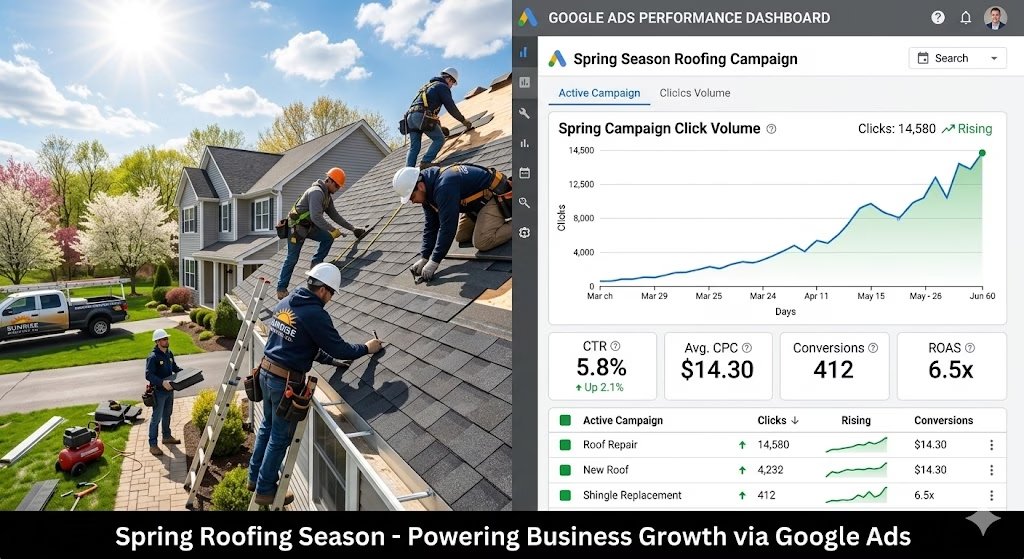
Spring Marketing Surge: How Roofing and Construction Companies Should Prepare Their Ads Before Peak Season
Read More